
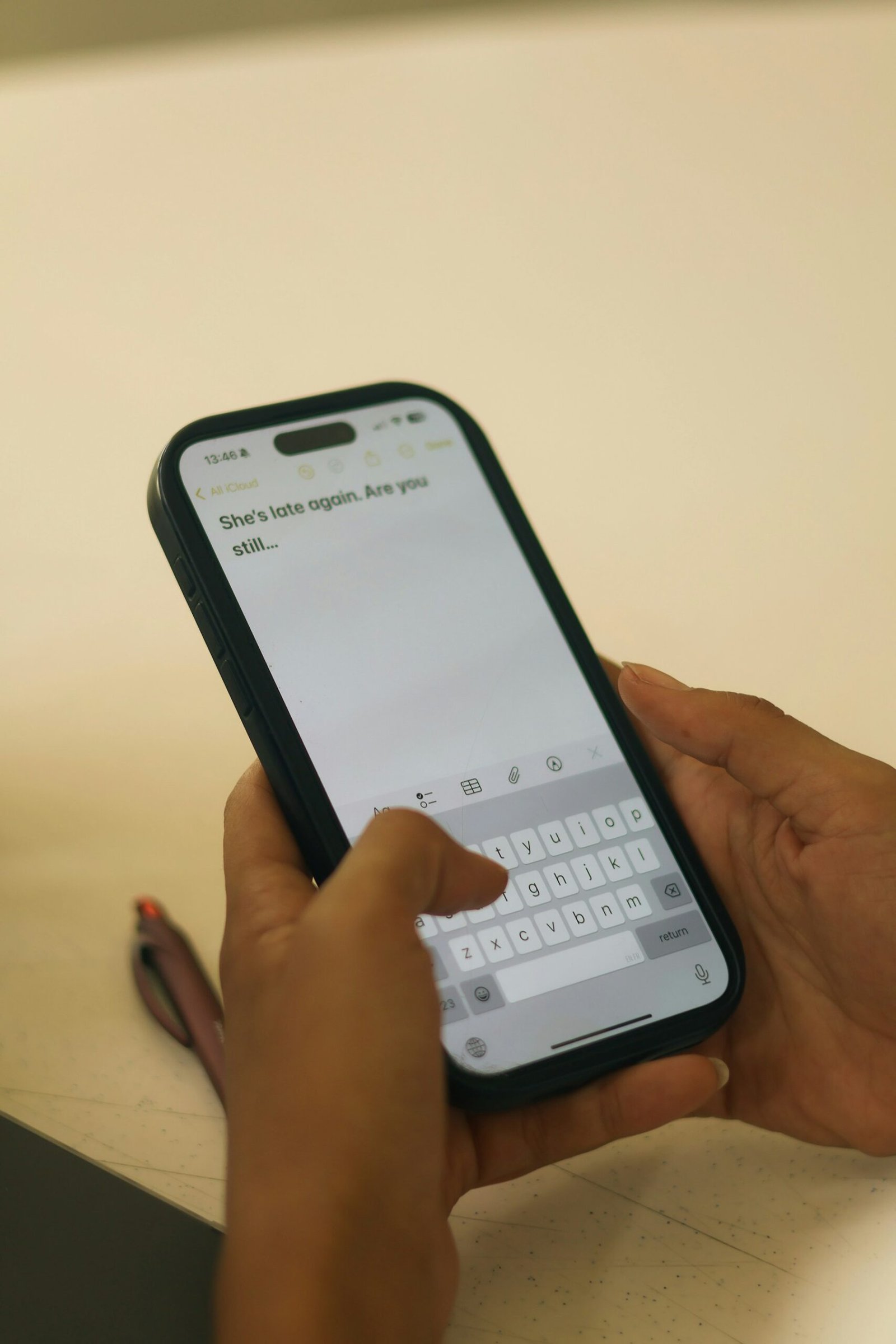
Since starting to study syntax, I’ve been noticing how people put sentences together in messages. WhatsApp and Messenger suddenly look a bit different when you start paying attention to subjects, verbs and all those little words between them.
One pattern caught my attention: someone names a person, then immediately uses a pronoun.
THE PATTERN THAT CAUGHT MY ATTENTION
“Maya, she does that all the time.”
Is she unnecessary? Would a teacher cross it out? Is this something to do with signing?
The answer is more interesting than “that’s bad English”.
The examples below are invented to illustrate sentence structures. They are not quotations from anyone’s private messages. This is a personal reflection, not a study of deaf people’s writing.
A name followed by a pronoun
Compare these sentences:
STRAIGHTFORWARD STATEMENT
“Maya does that all the time.”
TOPIC FIRST, THEN A COMMENT
“Maya, she does that all the time.”
Topic: Maya
Comment: she does that all the time.
The first is a straightforward statement. The second can set up Maya as the topic, then say something about her.
You can think of it as:
ANOTHER WAY TO UNDERSTAND IT
“As for Maya, she does that all the time.”
Linguists call this kind of structure left dislocation. The name sits before the main clause, where a pronoun refers back to it. Cambridge’s grammar describes similar structures as headers: they help establish what the speaker is talking about. They occur in informal spoken English, including hearing people’s speech. Cambridge English Grammar Today
So a name followed by she or he does not, by itself, show that someone has made a grammatical mistake. In formal writing, we might prefer the shorter version. In a conversational message, the longer version can sound natural.
A comma helps show the intended structure, but people rarely punctuate every WhatsApp message carefully. Without the surrounding conversation, we may also be looking at a restart: someone begins with a name, then starts their sentence again.
Some differences really do involve English grammar
Other patterns deserve a different explanation. Consider these invented examples:
1. Adding am
MESSAGE-STYLE EXAMPLE“I happy with the result.”
STANDARD ENGLISH“I’m happy with the result.”
What changes? English normally needs am here.
2. Adding is
MESSAGE-STYLE EXAMPLE“She working tomorrow.”
STANDARD ENGLISH“She’s working tomorrow.”
What changes? The progressive construction needs is.
3. Adding to
MESSAGE-STYLE EXAMPLE“I want visit the exhibition.”
STANDARD ENGLISH“I want to visit the exhibition.”
What changes? Want takes to before the following verb in this construction.
4. Adding a
MESSAGE-STYLE EXAMPLE“He bought new bicycle.”
STANDARD ENGLISH“He bought a new bicycle.”
What changes? A singular count noun normally needs a determiner here.
5. Adding -s
MESSAGE-STYLE EXAMPLE“My sister work nearby.”
STANDARD ENGLISH“My sister works nearby.”
What changes? Standard present-tense agreement adds -s.
These changes matter if someone wants to write standard English. But identifying a difference is only the first step. It does not tell us why the person wrote it, how often they use it, or what they know about English.
An occasional missing word might be a typing slip. A repeated pattern might be useful to explore with the writer. Neither gives us a complete picture of their language ability.
Messages aren’t essays
Now consider:
EVERYDAY TEXTING FRAGMENTS
These are ordinary conversational messages. They leave things unsaid because the conversation supplies the missing information.
If I ask “When are you coming?” and you reply “Probably tomorrow”, your answer works perfectly. You do not need to write “I will probably come tomorrow”.
That matters when discussing deaf people’s messages. We should not treat every short sentence as a difficulty with English while accepting the same thing as normal texting from a hearing person.
Sometimes it does. Sometimes a missing word makes the meaning uncertain. Those are different situations.
Where does sign language fit?
British Sign Language has its own vocabulary and grammar. It is a language in its own right, rather than English represented on the hands. English may be a second or third language for some BSL users. UCL’s Deafness Cognition and Language Research Centre
For someone whose first language is BSL, a topic-first sentence such as “Maya, she does that” may reflect how they organise information when signing. BSL could influence their written English, and that possibility deserves attention.
Similar structures also occur in conversational English. To find out whether they are more frequent among BSL-first-language users, we would need comparable samples of messages from BSL-first-language and English-first-language users, alongside information about their language backgrounds and the contexts in which they are writing.
There isn’t one “deaf syntax”
The messages I have been thinking about vary considerably. Some contain long, carefully structured sentences. Some use short conversational fragments. Others show recurring differences from standard written English.
Even one person’s writing can vary between an excited message to a friend and a carefully prepared public announcement.
My informal observations cannot tell us how common any pattern is across deaf communities. They also cannot establish whether deaf people use it more often than hearing people. That would require a properly designed comparison, rather than a collection of memorable examples.
There is another question here: how well do messaging platforms support the languages people actually want to use?
A 2020 study, involving seven interviews and a survey of 60 Deaf signers, found that participants shared most often in written English despite wanting to share in sign language. The researchers also identified barriers to creating and accessing signed content. This was a study of social-app accessibility, not proof of a particular “deaf grammar”. Mack and colleagues, Social App Accessibility for Deaf Signers
What I want to notice more carefully
Studying syntax has made me more curious about the structure of messages. It has also made me more cautious about calling something wrong.
“Maya, she does that” can organise a conversation around a topic. “At the station” can be a complete answer in context. “I want visit” differs from the standard English construction and may be something a writer wants help with.
Those distinctions are useful. They let us explain English clearly without turning someone’s everyday messages into a judgement about their intelligence.
If someone asks for feedback, I want to be able to say: “Here’s how this sentence works. Here’s the standard written version. What did you want it to mean?”
That seems a much better place to start than “Your grammar is bad.”
Featured photo by Chidera Faustina Okeke on Unsplash.
Leave a Reply